
■ Constraints are not the enemy—they are the starting point of design
Once I decided to build a garage shed,
the first thing I faced was constraints.
The small size of the lot, building regulations,
and the relationship with the existing house.
These aren’t obstacles that take away freedom—
they are the conditions that allow design to begin.
This was the start of my dialogue with reality.
There are three main points.
Here is the first.
【First Constraint】
Follow all building regulations
— As a former architect, this was the one thing I absolutely couldn’t compromise.
When I committed to building the garage shed,
the very first thing I examined was the law.
Lot size, distance from the road,
relationship with the existing structure—
even for a small shed, there are many rules to follow.
In fact, because it’s small,
the boundary between “allowed” and “not allowed” becomes even more ambiguous.
■ Even under 10㎡, the Building Standards Act still applies
This is a bit difficult to phrase,
but recently I’ve seen many DIY shed‑building videos on YouTube.
People often say, “Under 10㎡, so no building permit required.”
But—
There is no law that says
“Under 10㎡, therefore you don’t have to follow the Building Standards Act.”
If a neighbor or the city office says,
“This is an illegal structure,”
you may be forced to remove it.
Imagine tearing down a garage you spent money and time to build.
And more importantly—
is it truly safe in an earthquake or fire?
What I’m putting inside is the Seven, something precious.
It’s too late once something happens.
That’s why I didn’t want to treat this as “just a hobby.”
Applying for a building confirmation was the natural choice.
■ Key points of the confirmation process
From here, I’ll explain using simple illustrations.
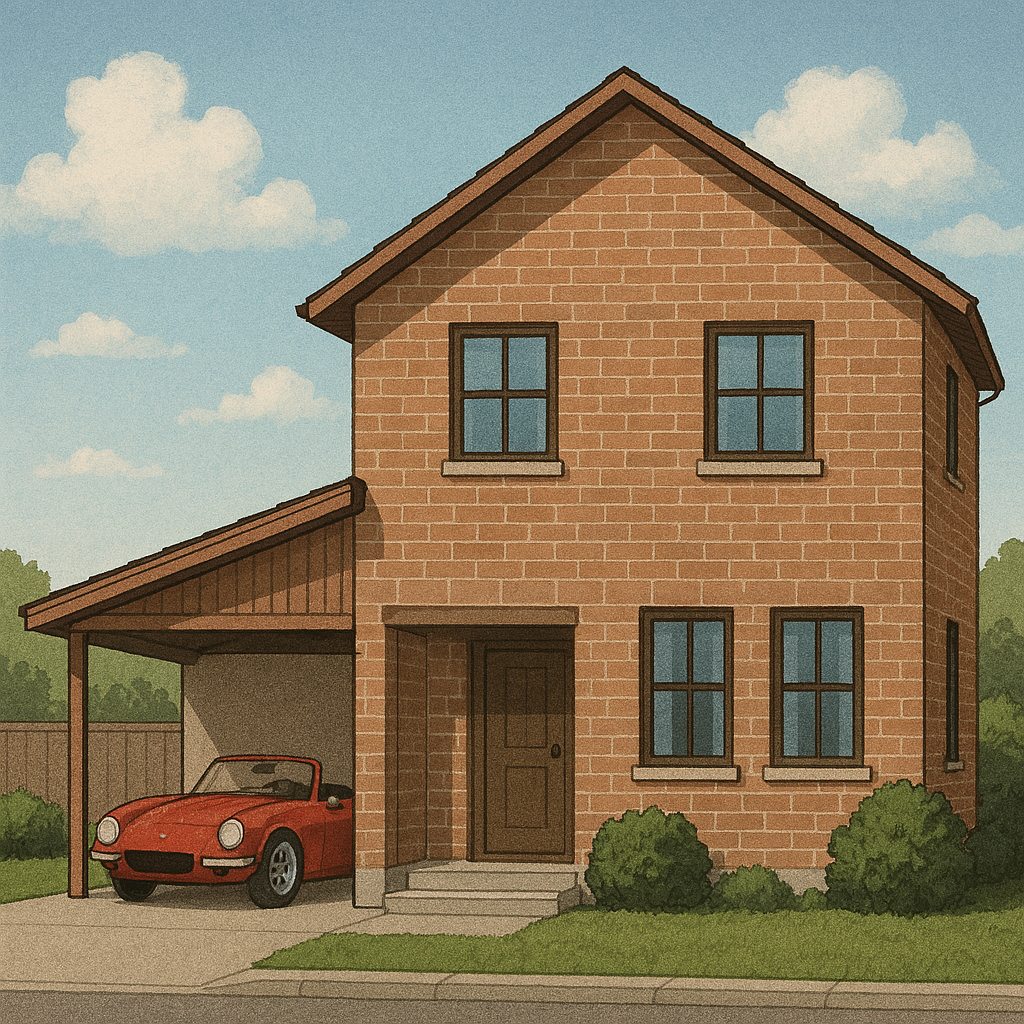
Point 1: Design it as a completely separate structure
There is a method where you attach the new roof or walls
to the existing house’s columns or beams.
But if you do that, you trigger the concept of retroactive compliance.
Meaning:
- The entire existing house must undergo confirmation again
- Installation of 24‑hour ventilation systems
- Structural calculations required
- Foundations must be integrated
For a hobby project, this is far too heavy—
both in workload and cost.
So I designed it as a fully independent, separate structure.
This minimized the impact on the existing house
and kept the legal process simple.
● ポイント2:Clear the road‑setback height limit using “Sky Exposure Ratio”
This is technical, but for those interested:
“Introduction to Sky Exposure Ratio – Seikatsu Sangyo Institute”
The garage shed needed to be built close to the road.
That meant it would violate the road‑setback height restriction.
This system didn’t exist when the house was built 30 years ago,
but now the Sky Exposure Ratio method can be used as a relaxation measure.
専門的ですが、関心ある方は、どうぞ はじめての天空率 – 生活産業研究所株式会社
I ran the calculations on my PC,
and once the shed cleared the restriction using this method,
the design could finally move forward.
■Summary: Regulations are not the enemy—they are the starting point
Even for a small garage shed—
no, because it is small—
you must read the regulations carefully.
Constraints do not take away freedom.
They are conditions that protect safety and peace of mind.
And finding solutions within those conditions
is one of the true joys of DIY.
Next Episode
② Keeping costs down — DIY and partial contracting